Industry News
Latest Bearing Industry News & Solutions


Latest Bearing Industry News & Solutions
Does your toy car, fan, or small appliance motor sound rough, run hot, or wobble on its shaft? Nine times out of ten, the fix is a small DC motor replacement bearing. Replacing a worn bearing is cheap, quick, and can give a dying motor a second life — but choosing the wrong one will ruin the motor in minutes. This guide shows you how to pick the right DC motor replacement bearing and install it correctly.
When Should You Replace a DC Motor Bearing?
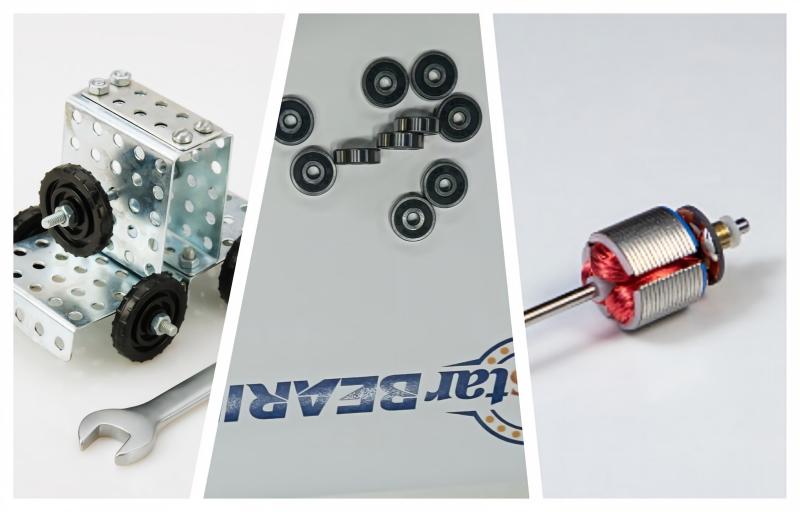
Small DC motors — found in toys, drones, model cars, cooling fans, and light automation equipment — use miniature ball bearings or bushings that wear out over time. Look for these warning signs:
Noise: a whine, rattle, or grinding sound at speed — the clearest signal
Shaft wobble: play in the shaft when you push it sideways
Overheating: the motor case gets hot even at light load
Poor performance: lower speed or reduced torque than before
If you notice any of these, inspect the motor. In most cases, the replacement bearing is the only part you need to change.
How to Identify the Right Replacement Bearing
Choosing the correct small motor replacement bearing comes down to three measurements. Use a digital caliper — do not guess.
1. Measure the bore (shaft diameter)
This is the inner hole size and it decides the bearing number. A 4 mm shaft needs a bearing with a 4 mm bore. If the old bearing is still readable, the number printed on the shield tells you directly: for example, 624 means a 4 mm bore.
2. Measure the outer diameter
The bearing must fit the motor housing. A 634 (16 mm OD) will not fit a housing machined for a 624 (13 mm OD), even though both have 4 mm bores.
3. Measure the width
The third dimension must match the housing slot; a wider bearing can bind against the end cap.
Common sizes you will meet
| Bearing | Bore × OD × Width (mm) | Typical motor |
| 623 | 3x10x4 | Tiny gear motors |
| 624 | 4x13x5 | Toy motors, small pumps |
| 634 | 4x16x5 | Toy DC motors, model motors |
| 625 | 5x16x5 | Small fan motors |
| 686 | 6x13x5 | Drone and gimbal motors |
| 608 | 8x22x7 | Skateboards, scooters, large hobby motors |
Always verify with a caliper — printed numbers can be worn or misread.
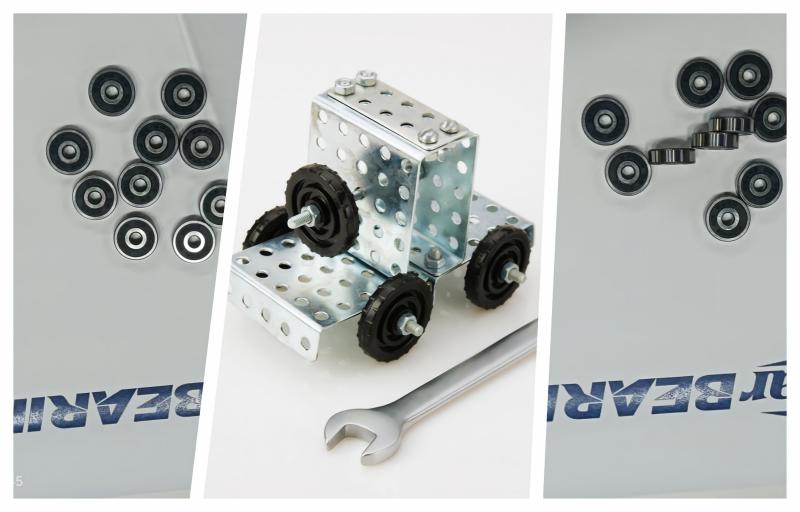
2RS (rubber seals) — best for motors exposed to dust and drops; keeps contamination out
ZZ (metal shields) — lower friction, slightly higher speed; for cleaner environments
Chrome steel — standard, affordable, fine for most applications
Stainless steel — for moisture or corrosive environments
Ceramic hybrid — for extreme speed and heat (rarely needed in small DC motors)
4. Quality gradeFor small motors, a good standard-grade miniature ball bearing for toy motor use is sufficient. Precision grades (ABEC 5 and above) only matter for high-speed or instrument applications.
Disconnect power and remove the motor from the equipment.
Open the end cap — usually held by two small screws or pressed clips. Note how the parts come apart.
Remove the old bearing — use a bearing puller, or gently tap the shaft end with a soft-faced hammer while supporting the housing. Never hit the bearing outer ring directly.
Clean the shaft and housing — remove old grease, dirt, and burrs.
Press in the new bearing — apply pressure only to the outer ring (for the housing fit) or inner ring (for the shaft fit). A small arbor press is ideal; a socket slightly larger than the bearing works too.
Reassemble — make sure the shaft spins freely and there is no binding before closing the end cap.
Test — run the motor unloaded first; it should spin quietly with no grinding.
Common Mistakes to Avoid
Hammering the outer ring — damages the raceways and ruins a new bearing immediately
Choosing the wrong bore — a 624 will not fit a 4.5 mm shaft; measure twice
Using the wrong seal — open bearings in dusty toys die fast; use 2RS
Reusing old grease — always fit a fresh, pre-lubricated sealed bearing unless the motor has a grease nipple
Forcing a tight fit — if the bearing will not slide in by light pressure, the housing may be damaged; fix it instead of forcing
Frequently Asked Questions
How do I know what size bearing my DC motor needs?
Measure the shaft diameter, the housing bore, and the housing width with a caliper, then match them to the bearing table above.
What is the difference between 624 and 634 bearings?
Both have a 4 mm bore. The 634 has a larger outer diameter (16 mm vs 13 mm) and is wider, giving higher load capacity and better shaft stability.
Can I use a shielded (ZZ) bearing instead of a sealed (2RS) one?
Yes, if the environment is clean. For toys, dusty workshops, or outdoor equipment, 2RS sealed bearings last much longer.
Do replacement motor bearings come pre-lubricated?
Sealed and shielded bearings are pre-lubricated for life — install them straight from the pack. Never add extra grease.
Why does my new bearing still make noise?
Check alignment, shaft straightness, and housing fit. Noise after replacement is usually an installation issue, not a bearing defect.
Where to Get Reliable DC Motor Replacement Bearings
Jakstar Bearing is a professional bearing supplier based in the Wuxi bearing industrial zone, China. We stock the complete miniature bearing range — 623, 624, 634, 625, 686, 608 and more — covering all the common small DC motor sizes, plus custom bore sizes made to your drawings.
For a full introduction to toy motor bearings and size selection, see our Toy Motor Bearings Guide.
Whether you need one bearing for a repair or bulk quantities for production, we reply with catalogue and quotation within 24 hours. Contact us today.
🌐 www.jakstarbearing.com