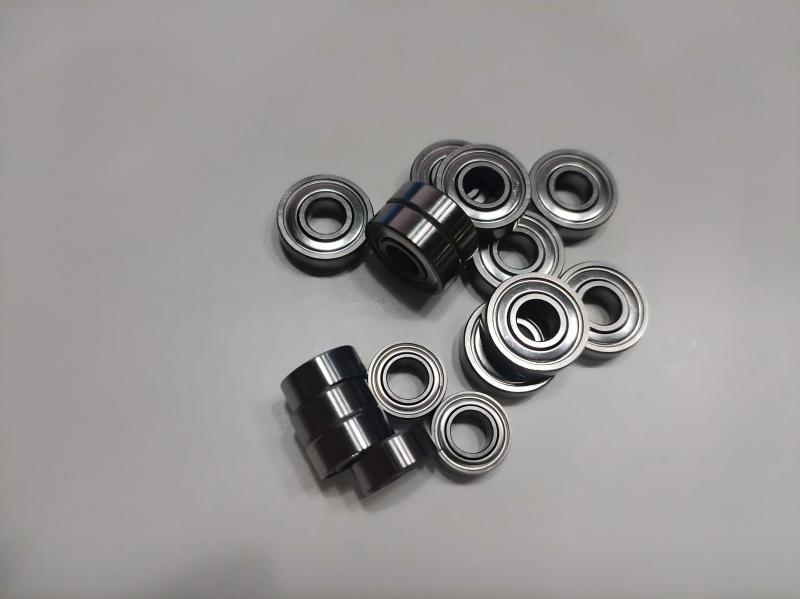
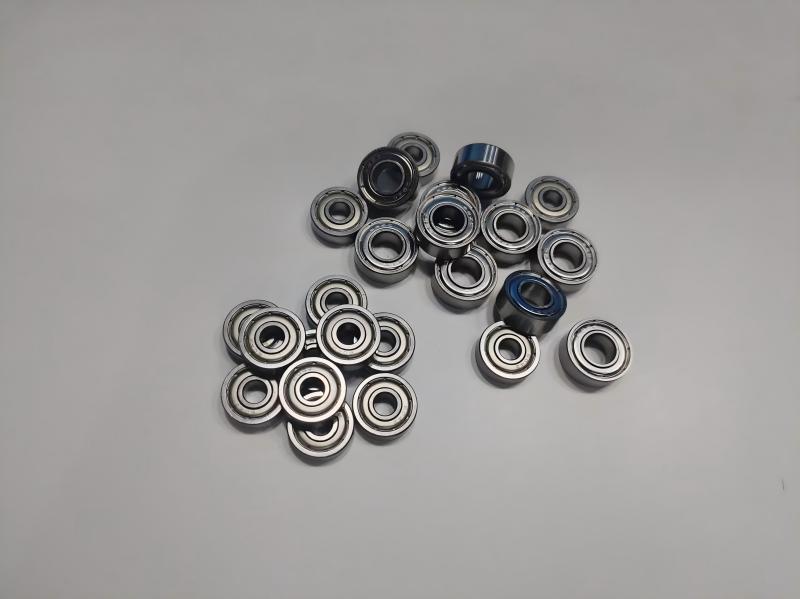
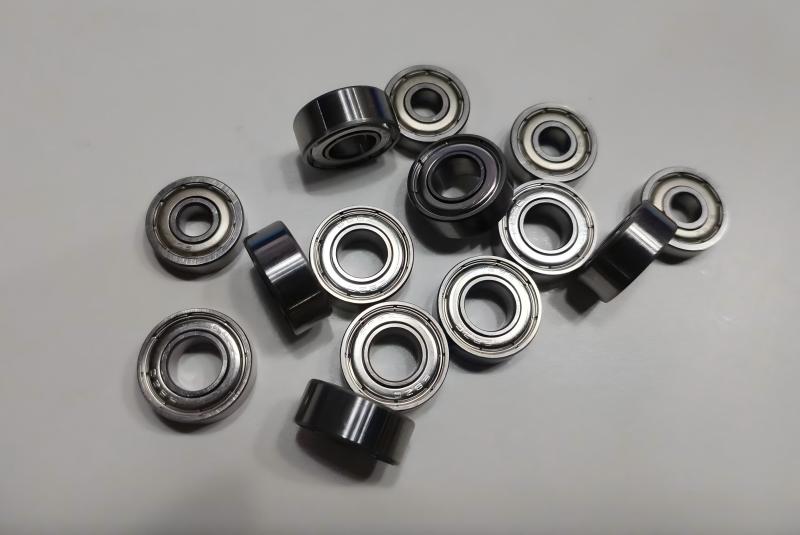
A miniature bearing is a small rolling-element bearing, usually with an outer diameter below 9 mm, designed to operate under light to moderate loads with high precision. What makes a bearing "custom" is that every dimension, material, cage design, seal, and lubrication specification is tailored to a particular application rather than copied from a catalog.
Custom bearing design engineering is a collaborative process. The customer shares their load conditions, speed, operating temperature, noise limits, and space constraints, and the manufacturer translates those requirements into a manufacturable part. Common customizations include special bore sizes, flanges, extended inner rings, non-standard materials such as ceramic hybrids, and custom grease types for low-noise or high-temperature operation.
For many applications, the standard miniature deep groove ball bearing remains the workhorse. It is versatile, quiet, and capable of both radial and light axial loads. When standard configurations cannot meet the requirement, engineers turn to a bespoke design to close the gap.
Bearing Types and Common Sizes
Miniature Deep Groove Ball Bearings
The
miniature deep groove ball bearing is the most widely used type in precision equipment. It features a deep raceway that accommodates both radial and axial loads in either direction, making it ideal for compact motorized and instrument applications. Typical bore sizes range from 1 mm to 9 mm, with outer diameters up to 26 mm.
One frequently requested size is the 608 bearing, a shallow-groove deep groove ball bearing with a 8 mm bore, 22 mm outer diameter, and 7 mm width. While the 608 is technically a standard part, it is often re-engineered for specialized performance, such as hybrid ceramic balls for high-speed use or modified seals for contamination-prone environments. Even a standard 608 can be customized through material selection and lubrication.
Flanged and Shielded Variants
Beyond plain open bearings, custom miniature bearings frequently include flanged outer rings, which simplify axial location in housings, and shielded or sealed variants that protect the raceways from dust and moisture. Choosing between metal shields and rubber seals depends on the operating environment and expected maintenance schedule.
Key Applications of Custom Miniature Bearings
Medical and Pharmaceutical Bearings
Reliability is non-negotiable in healthcare equipment. A miniature medical bearing must run quietly, smoothly, and without lubrication migration that could contaminate a device. These bearings appear in surgical instruments, dental handpieces, drug delivery pumps, and imaging systems where precise rotation directly affects patient outcomes.
Pharmaceutical bearings serve production machinery as well, including tablet presses, filling lines, and conveyors that must maintain cleanliness and repeatable motion through long production runs. In these settings, bearing materials and lubricants are selected to resist cleaning agents and minimize particulate generation.
Optical Instrument Bearings
Optical instrument bearings support the precision rotation required by microscopes, telescopes, surveying equipment, cameras, and laser systems. Because any runout or vibration degrades image quality, these bearings demand extremely tight tolerances and minimal noise. Custom designs often specify preload to eliminate play and polished raceways to reduce friction.
Power Tool Bearings
Bearings for handheld power tools face a very different challenge: they must survive shock loads, high speeds, and temperature swings in a compact package. Power tool bearings in drills, grinders, and rotary tools are engineered for durability and smooth operation. Customization focuses on cage strength, seal performance, and lubrication that resists degradation from heat and debris.
Automation Bearings
Modern factories rely on precision bearings for industrial automation market applications, including robotic arms, actuators, servo motors, and pick-and-place systems. Automation bearings supplier selection matters because downtime in a production line is extremely costly. Custom miniature bearings for automation are often designed with low friction, high rigidity, and consistent torque to enable accurate positioning and repeatable cycles.
Custom Bearing Design Services
Professional bearing design services begin with a detailed engineering review. The design team evaluates the application's load profile, speed, expected life, environmental conditions, and mounting arrangement. Using this information, they propose a bearing configuration, select appropriate materials and lubricants, and calculate the expected performance.
Customers ask us to design bearings for everything from one-off prototypes to production runs. Whether you need a design bearing for a new medical instrument or an optimized variant of an existing size, the goal is the same: a component that meets your performance targets and is economical to produce.
The most effective custom projects treat bearing design as a partnership, which is why buyers increasingly choose custom bearings over standard alternatives. Early involvement means design engineers can flag potential issues before tooling begins, saving time and cost. When a customer provides a complete specification, the supplier can usually deliver a functional sample quickly for validation.
Small Volume Bearing Supply
One of the biggest barriers for startups and specialty OEMs is minimum order quantities. Traditional large factories may require thousands of units per order, which is impractical for prototyping or low-volume products. Small volume bearing supply solves this problem by allowing customers to order batches tailored to their actual needs, from a few dozen to a few thousand pieces. In practice, small volume bearing production of this kind suits buyers who cannot commit to large stock or long lead times.
Small-batch capability matters in three ways. First, it enables prototyping: engineers can test a custom design in the field before committing to volume. Second, it supports niche products with modest but steady demand, such as specialized medical instruments and optical equipment. Third, it reduces inventory risk for resellers who cannot predict demand precisely. Because small production runs require flexible tooling and skilled operators, they are best handled by a supplier that specializes in precision short-run work.
How Custom Bearings Are Produced
Understanding the bearing manufacturing process flow chart helps buyers make better sourcing decisions. The production of a
precision miniature bearing follows several controlled stages.
Material Preparation and Turning
Raw steel or stainless steel bar is cut and machined to form the inner and outer rings. Hardened bearing steel such as 52100 is standard for most applications, while stainless steel is chosen when corrosion resistance is required. For hybrid bearings, ceramic balls are paired with steel rings to reduce weight and improve speed capability.
Grinding and Lapping
After heat treatment, the rings are ground and lapped to achieve the final dimensions and surface finish. This step determines the bearing's running accuracy. Ultra-precision grinding produces the roundness and surface quality that miniature bearings need for low noise and smooth rotation.
Raceway and Cage Assembly
The raceways are finished, and the ball complement and cage are assembled. The cage keeps the balls evenly spaced and prevents contact between adjacent balls. Custom cages can be made from steel, brass, or engineered polymers depending on speed and noise requirements.
Inspection and Testing
Every batch is inspected for dimensional accuracy, radial and axial runout, and noise. Sealed and shielded bearings are tested for seal integrity, and lubricated bearings are checked for the correct fill and operating torque. Final quality control ensures each bearing meets the agreed specification before shipment.
Serving Global Customers
Custom miniature bearings serve a genuinely international market. Suppliers support clients in the United Kingdom, where custom bearing design uk inquiries often focus on medical and aerospace prototypes. The company also serves customers across Europe, including Italy, where buyers searching for cuscinetti in miniatura or a specific cuscinetto 608 find dedicated multilingual support. In French-speaking markets, requests for a roulement miniature are handled with the same engineering care.
Because these parts are compact and lightweight, international shipping is fast and economical. Export documentation, customs clearance, and multilingual technical communication are managed so that a customer in any country can receive a precise, functional bearing without friction.
Why Choose a Specialized Custom Bearing Supplier
Choosing a supplier is about more than price. A specialized supplier brings engineering depth, flexible supply, and reliable communication. The best partners:
Offer genuine design support rather than pushing catalog parts.
Accept small and medium batch sizes that suit prototypes and niche products.
Provide transparent lead times and quality documentation.
Communicate clearly across time zones and languages.
For a business that needs a bearing tailored to one specific product, working with a team that understands both bearing design and short-run production is the difference between a part that barely works and a part that delivers years of reliable service.
Frequently Asked Questions
How small can a custom miniature bearing be? Bore sizes can be made as small as 1 mm, with overall bearing diameters scaled to match your space constraints.
What is the typical minimum order quantity? We support small volume bearing supply, with batches starting from a few dozen pieces, making prototyping and niche products practical.
How long does a custom design take? A standard design modification can be sampled quickly; entirely new designs require a short engineering and tooling phase to ensure accuracy.
Can you provide multilingual support? Yes. Our team works with customers in English, Italian, and French-speaking markets, among others.
Conclusion
Custom miniature precision bearings are the quiet foundation of modern precision equipment. From a medical miniature ball bearing that keeps a surgical handpiece smooth, to bearings for handheld power tools that survive heavy use, to precision bearings for industrial automation market systems that run around the clock, the right bearing makes the difference. By combining genuine custom bearing design engineering with small-batch supply and global service, suppliers can deliver exactly the component their customers need.
If you are designing a new product or optimizing an existing one, start the conversation early. Share your application and requirements, and let the engineering team design bearing solutions that fit your exact specifications. Whether you need one reliable custom bearing or a steady supply for a growing product line, the path begins with a single design review.