Industry News
Latest Bearing Industry News & Solutions


Latest Bearing Industry News & Solutions
Power tools are the harshest environment a miniature bearing will ever meet in a consumer or light-industrial product. A hand drill bearing may spend five minutes of its life running smoothly and the rest absorbing the shock of a masonry bit jamming in concrete. An angle grinder spindle turns at 11,000 rpm in a cloud of metal dust and abrasive grit, then gets put down on a bench while still hot, then picked up again. A rotary hammer delivers impact energy in the hundreds of joules per minute through a crank and piston assembly that relies on small bearings to stay aligned.
That combination — high speed, violent shock, continuous contamination, and a price ceiling set by retail competition — is what makes power tool bearings a genuinely difficult specification problem rather than a commodity purchase. A bearing that survives in a fan motor will fail in a grinder within a season; a bearing that survives in a grinder may be over-specified, and therefore too expensive, for a 12 V drill.
This guide covers where bearings sit inside the main power tool categories, which parameters actually determine service life, how to read a specification properly, and what to verify when sourcing.
Shock loading. Impact tools and hammer drills transmit load as discrete pulses rather than steady torque. Bearings in these positions see repeated high-peak loads that brinell raceways if the steel or the heat treatment is marginal. Static load ratings in the catalogue rarely describe this duty; field life is governed by fatigue resistance under cyclic impact.
High rotational speed. A small angle grinder runs at roughly 11,000 rpm at no load, and die grinders on compressed air or high-frequency motors go considerably higher. For a 6 mm bore bearing this means the ball passage frequency and the grease's ability to stay in the raceway become the limiting factors. Power tool bearings 6mm bore size high speed rated is not marketing phrasing — the speed rating genuinely depends on bore size, cage type, grease fill, and whether the bearing is open or shielded.
Contamination. Cutting dust, masonry fines, metal swarf and coolant spray all reach the bearing from the working end. Sealing choice matters more here than in almost any other miniature bearing application.
Cost pressure. Power tools are sold at retail price points where the total bearing cost per unit is often a few percent of the bill of materials. There is real pressure to downgrade, and the downgrade usually shows up as warranty returns in the second season rather than at first inspection.
Understanding which bearing fails in which tool is the fastest route to correct specification.
A cordless drill has two rotating subsystems. The motor itself uses very small bearings — typically 3 to 4 mm bore — which are usually adequate because motor speed is high but load is low and the housing is sealed by the tool body.
The more demanding position is the output spindle. Cordless drill spindle bearings carry the chuck, absorb the side load the operator applies when drilling, and must hold the spindle concentric so the bit does not wander. In most designs the spindle is supported by a pair of small deep groove ball bearings, sometimes with one flanged bearing to provide axial location against a machined shoulder in the gearbox housing.
The key specification here is radial clearance and mounting fit, not precision class. A spindle bearing that is even slightly loose in its housing will allow the chuck to run out, which the user experiences as a wobbling bit and drilled holes that are oversized. Conversely, a bearing pressed too tightly loses clearance and runs hot. Power drill chuck support bearings are one of the most common sources of "the drill vibrates" complaints after a rebuild.
The grinder spindle is the highest-speed, most contaminated bearing position in the tool. Handheld grinder radial bearings sit close to the abrasive disc, exposed to metal particles, and must tolerate temperatures that rise quickly during sustained cutting.
Two design details dominate. First, the bearing must run with the correct internal clearance at operating temperature; a grinder spindle that heats to 70–80 °C loses clearance, and a C2 bearing will preload and seize where a standard or C3 bearing runs freely. Second, sealing must exclude fine metal dust without adding so much friction that the grease overheats. Rubber-sealed bearings with a defined IP rating are the practical answer in this position, and open bearings with an external labyrinth are only acceptable when the housing provides a genuine dust path away from the raceway.
Spindle runout also matters directly: an abrasive disc mounted on a spindle supported by a bearing with measurable runout produces vibration the operator feels in their hands, and vibration is the number one complaint category for grinders.
A rotary hammer converts motor rotation into a reciprocating piston stroke plus a rotary impact. The rotary hammer piston bearings — and the crank or wobble-plate bearings that drive them — operate under the most punishing load profile in the whole power tool family.
These positions see reciprocating load rather than continuous rotation, which means the bearing does not complete full revolutions and lubrication distribution is uneven. They also see peak shock loads during idle-impact and when the bit binds. In many designs this position uses a needle or roller bearing rather than a ball bearing, because the load is predominantly radial and the available radial height is minimal.
Grease selection here is the difference between a tool that lasts five years and one that fails in eighteen months. A grease formulated for oscillating motion and high shock, with good adhesion so it does not migrate away from the loaded zone, is essential.
The impact mechanism of an electric or cordless impact wrench is built around a hammer and anvil, and the small bearings in that mechanism are almost always needle or roller types. Electric impact wrench needle bearings handle very high radial load in a very small envelope, which is precisely why the needle bearing geometry exists.
This is a specialist position with a narrow supplier base. It is worth noting that needle bearings for impact mechanisms are not a general catalogue item for most miniature bearing suppliers, and a tool manufacturer sourcing this position should expect to work from a drawing rather than a catalogue page.
Once the position is understood, specification reduces to five decisions.
Material and grade. Power tool bearings ABEC-5 precision chrome steel is the sensible standard for spindle, grinder and hammer positions. Chrome bearing steel — GCr15 or its equivalent 100Cr6 — gives the fatigue resistance these cyclic loads demand, and ABEC-5 / P5 tolerance keeps runout low enough for smooth operation at high speed. Standard ABEC-1 material in a grinder spindle is a false economy; the cost difference is small relative to the warranty risk.
Tolerance and dimensional control. In power tools the housing is often a die-cast or moulded component with its own tolerance band, and the bearing must fit it predictably across production batches. A supplier working to ±0.002 mm machining tolerance on critical dimensions gives consistent seating and avoids the classic production problem of a batch that presses in too tight and another that spins in the pocket.
Bore size and speed rating. Speed capability is not a single number. It depends on bore, cage, lubrication and shielding. When a drawing calls for a high speed rated bearing, confirm the rating is stated at the actual operating conditions — radial load and temperature — rather than a catalogue maximum reached under ideal laboratory conditions.
Sealing. In dusty applications, sealed beats shielded. Power tool bearings IP68 double sealed rubber describes a specification where the seal excludes both dust and water ingress, which matters for tools used outdoors, in wet cutting, or in marine and construction environments. The trade-off is friction and heat, so the seal must be matched to the speed — an IP68 seal on a high-speed spindle will generate more heat than the grease can tolerate unless the design accounts for it.
Clearance and lubrication. Clearance must be assessed at operating temperature, not at 20 °C. Lubrication must be matched to motion type: continuous rotation in grinders and drills, oscillation in hammer mechanisms, and shock loading in impact tools each want a different grease formulation.
For extreme duty applications, mixed ceramic hybrid composite bearings — steel rings with ceramic balls — offer lower friction and better high-speed behaviour, and they eliminate false brinelling during long storage. They are generally not the standard choice for mainstream power tool programmes because of cost, but they are a legitimate option where tool life or speed is the primary constraint and the price point allows it.
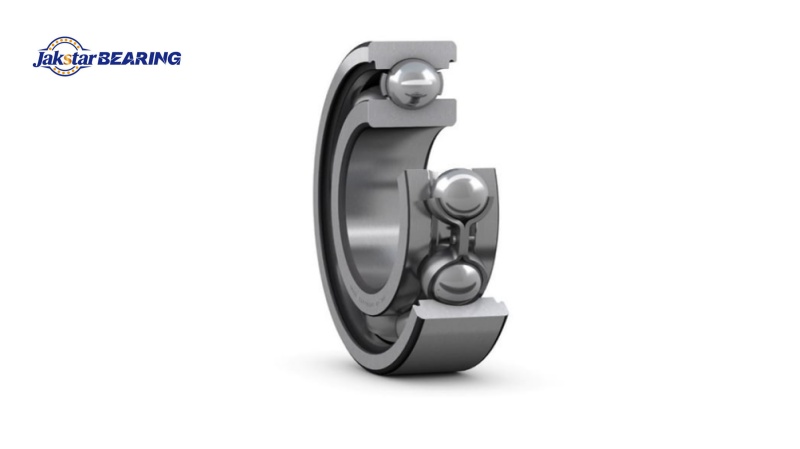
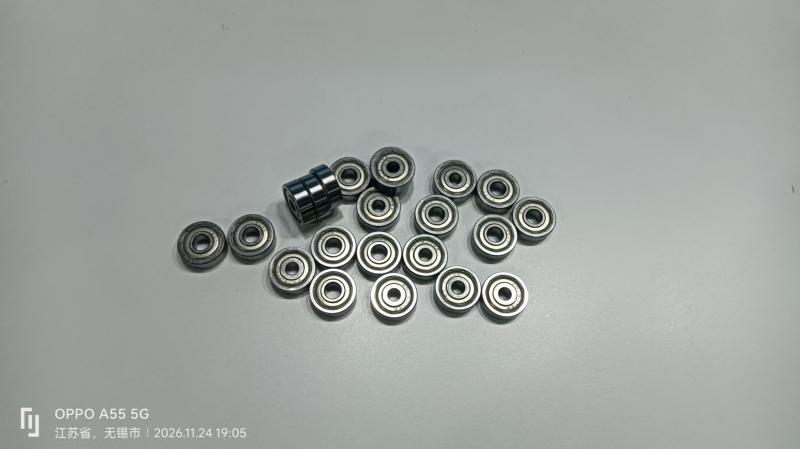
Miniature deep groove ball bearings cover the majority of positions: drill spindle support, grinder spindle, motor shafts, and gearbox output. Sizes in the 3 to 10 mm bore range, with metal shields or rubber seals, are the standard answer.
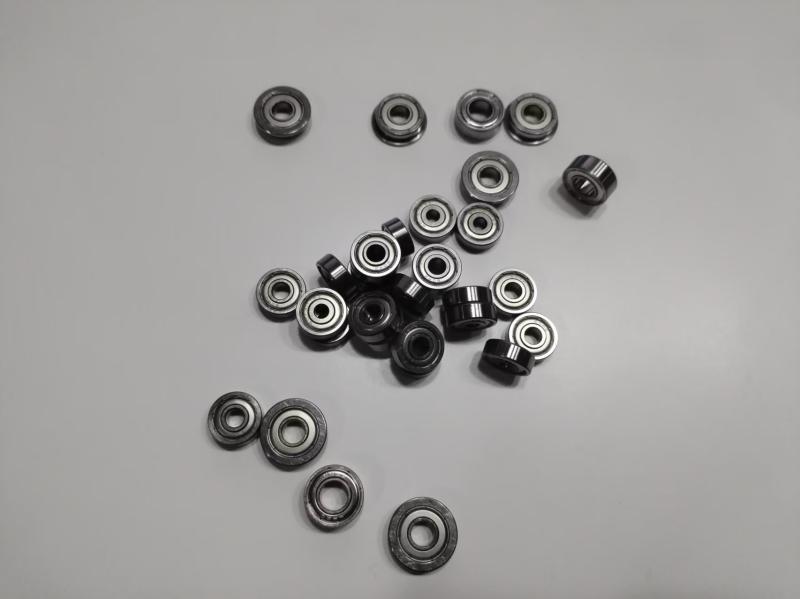
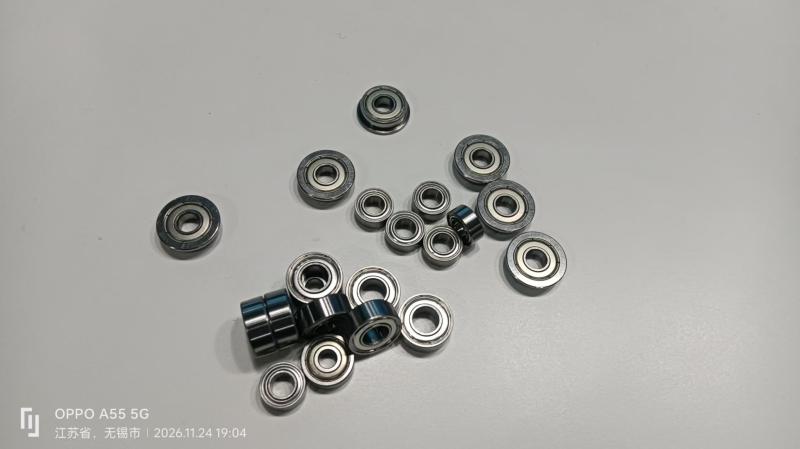
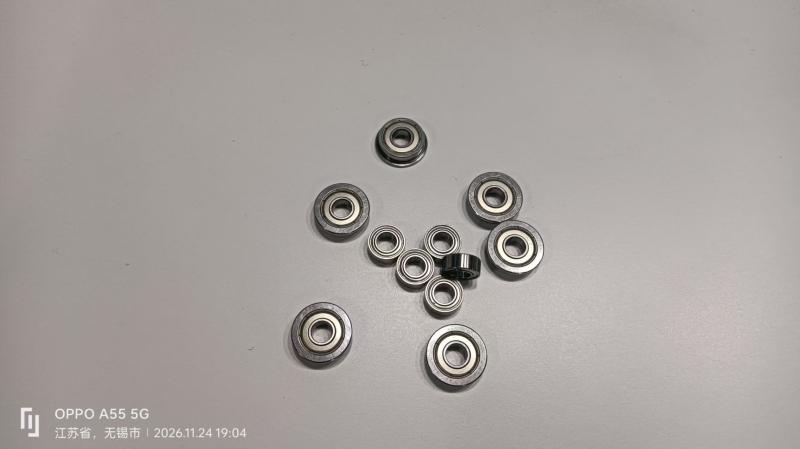
Flanged versions simplify axial location in die-cast and moulded housings, exactly as they do in printer feed modules — the flange replaces a machined shoulder and reduces machining cost in the housing.
Needle and roller bearings belong in reciprocating and impact mechanisms where radial load is high and radial space is tight: rotary hammer crank positions and impact wrench hammer mechanisms.
Non-standard geometries are common in power tools because the housing is designed first and the bearing is designed to fit it — wider rings, modified outer diameters, integrated seals, or plastic outer rings all appear in real production drawings. A supplier without drawing-based production capability cannot serve this demand.
Different end uses weight the specification differently, which is why a single bearing type does not serve every tool.
In cutting and grinding work, speed and contamination dominate. Bearings here need a high speed rating, tight runout, and sealing that excludes fine metal particles while surviving elevated temperature. A tool used continuously in a fabrication shop will expose the spindle bearing to conditions far beyond the rated duty of a DIY tool.
Wood dust is less abrasive than metal swarf but far more voluminous, and it accumulates inside housings. Seal integrity and grease adhesion are the priority; a bearing whose grease migrates out under centrifugal force collects dust and then grinds it into the raceway.
Brake rotor machining combines sustained load, coolant spray, and metal fines — conditions that stress both sealing and corrosion resistance. A bearing that rusts when the tool is stored wet between jobs will fail before its fatigue life is reached, so surface protection belongs in the specification.
Rotary hammer duty in construction is the shock-loading case: sustained impact, dust, and operator abuse. Bearing selection should favour shock-resistant material and heat treatment, appropriate clearance for temperature rise, and grease formulated for oscillating load.
Marine environments add salt and water ingress to the usual dust and load. IP-rated sealing and stainless or surface-treated rings become the deciding factors, and the bearing's cost becomes secondary to corrosion resistance.
Brinelling — indentations in the raceway — indicates shock load exceeding the bearing's capacity, or a bearing stored and installed under impact. In power tools it usually means the specification underestimated the impact duty.
Grease migration and dry running shows as discoloured or absent grease and a polished, overheated raceway. Causes: wrong grease for the motion type, excessive speed for the fill quantity, or seal friction raising temperature.
Contamination wear appears as dull, matte raceways with embedded particles. The seal was inadequate for the environment, or the housing lacked a dust path.
Spalling from fatigue — flaking of the raceway surface — points to load above the design rating or to marginal steel quality and heat treatment.
Spindle runout without visible bearing damage usually traces to housing fit rather than the bearing: a pocket machined oversize, or a bearing at the extreme of its outer diameter tolerance. This is why dimensional consistency of ±0.002 mm matters in production, not just in the sample.
Three purchasing realities shape this category.
Consistency across batches outweighs unit price. A power tool is a warranty item. A batch that runs 2 dB louder or 3 µm looser than the approved sample creates field returns even though every unit passed incoming inspection. Ask for per-batch noise, torque and dimensional data, not a single approval report.
Mixed, moderate volumes. Tool manufacturers and aftermarket rebuilders typically need several sizes in moderate quantities rather than one size in container loads. A supplier that supports small MOQ and mixed shipments is more useful than one with a lower price and a high minimum.
Drawing-based production. Because a significant share of power tool bearing demand is non-standard, the ability to produce from a customer drawing — with defined tolerances, seal specification and grease — is the capability that separates a real supplier from a reseller.
Position identified, with load type (rotation, oscillation, impact) confirmed
Speed rating stated at operating load and temperature, not catalogue maximum
Tolerance class justified by runout requirement
Internal clearance matched to operating temperature rise
Seal type matched to dust and moisture environment, with friction accounted for
Grease specified by motion type and temperature range, numerically
Dimensional tolerance on OD and bore confirmed as ±0.002 mm or as the housing requires
Sample approval covering at least two production batches
What bearings do power tools use?Mostly miniature deep groove ball bearings in 3–10 mm bore sizes for spindles, motors and gearboxes, with needle or roller bearings in impact and reciprocating mechanisms such as rotary hammers and impact wrenches.
Why do grinder bearings fail so quickly?Speed, heat and fine metal dust together. The usual cause is a seal that admits particles, a clearance that closes up at operating temperature, or grease that cannot survive the temperature and speed combination.
Is ABEC-5 necessary for all power tool bearings?No. ABEC-5 / P5 is appropriate for spindles and high-speed positions where runout affects the user's experience. Lower-precision positions can use ABEC-3 or ABEC-1 economically, provided material quality and heat treatment are not compromised.
Can a standard bearing replace an impact wrench needle bearing?No. Needle bearings in impact mechanisms are specified for the radial load and envelope of that position; a ball bearing of nominally similar size will not carry the load in the same space.
Power tool bearings fail predictably, and they fail for reasons that are visible in the specification long before they appear in a warranty claim. Identify the position, define load and speed at operating temperature, choose material and tolerance deliberately rather than by catalogue habit, and control fit consistency across batches. That sequence accounts for nearly every successful power tool bearing programme — and nearly every failed one.